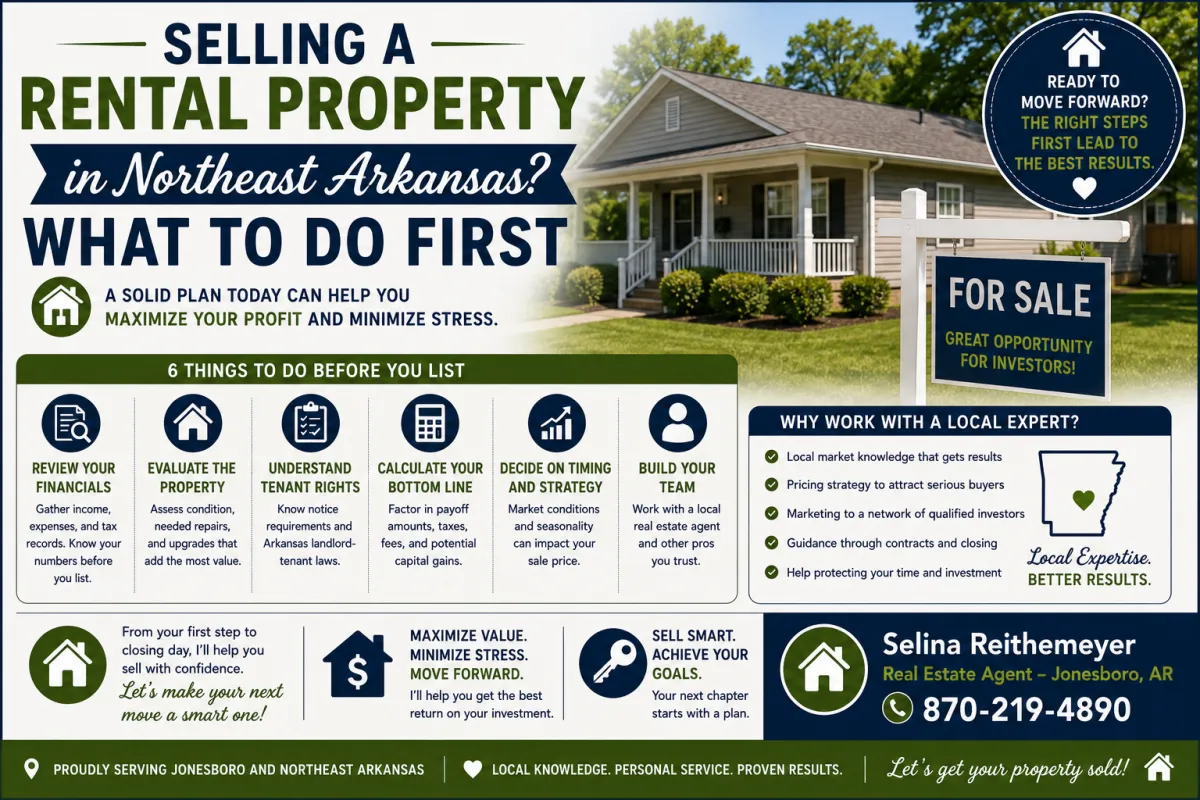
Selling a Rental Property in Northeast Arkansas? What to Do First
What Should You Do Before Listing a Rental Property for Sale in Northeast Arkansas?
Quick answer: Before listing a rental property for sale, review the lease, tenant situation, property condition, rental income, expenses, repairs, tax records, and likely market value. The national rental vacancy rate sat at 7.2-7.3% in late 2025/early 2026, according to U.S. Census Bureau data, a useful benchmark when evaluating how your property's occupancy history compares. A rental property should be evaluated differently from an owner-occupied home because buyers may care about both the property's condition and its income-producing potential.
Selling a rental property is different from selling the house you live in. You're not selling a building. You're selling an investment.
That means there are more questions to answer. What is the property worth? What does it rent for? What are the expenses? Is there a tenant? When does the lease end? What repairs are needed? And what will the buyer want to know?
Preparing those answers before listing can make the process much smoother.
Should You Sell With a Tenant in Place?
Possibly. There are advantages and disadvantages to both approaches.
A tenant in place may provide an immediate income stream for an investor buyer. But occupied properties can also make showings more complicated.
Before making a decision, review the lease and understand the rights and obligations of both landlord and tenant. If you're unsure about your legal obligations, consult the appropriate attorney or property-management professional.
What Documents Should You Gather?
Start organizing your records before putting the property on the market. Consider gathering: current lease, lease amendments, rent payment history, property tax records, insurance information, utility information, repair receipts, appliance warranties, contractor invoices, HOA documents, if applicable, and maintenance records.
A well-organized file can make it easier to answer buyer questions.
Should You Make Repairs Before Selling?
Maybe. The right answer depends on the repair.
Start with items that affect: safety, water intrusion, major systems, functionality, insurance, financing, and overall marketability.
Cosmetic improvements may also help, but don't assume every renovation will produce a dollar-for-dollar return. A rental property should be evaluated as an investment.
What About Deferred Maintenance?
Rental properties can accumulate maintenance issues because tenants use the property differently from an owner.
Before listing, inspect: roof, HVAC, plumbing, electrical, appliances, flooring, walls, exterior, landscaping, and drainage.
Understanding the property's condition helps you price it realistically. It also gives you an opportunity to address issues before they become surprises during the buyer's inspection.
Selling With a Tenant vs. Selling Vacant
| Sell With Tenant in Place | Sell Vacant |
|---|---|
| Immediate income stream appeals to investor buyers | Appeals to a wider buyer pool, including owner-occupants |
| Easier to market income and lease terms confidently | Easier to stage, show, and photograph the property |
| Showings may require tenant coordination and notice | No rental income during the listing period |
| Buyer must review and honor the existing lease | Buyer has full flexibility on move-in or re-leasing timing |
How Do You Determine What a Rental Property Is Worth?
A rental property can be evaluated using several approaches. A real estate professional may look at: recent comparable sales, location, condition, property size, lot, rental income, expenses, current market demand, and investment appeal.
The property's income can be important to investor buyers. But the market value of the real estate still matters.
Should You Tell Buyers What the Property Rents For?
If you're marketing the property as an investment, rental information can be important.
Buyers may want to understand: current rent, lease terms, deposit, tenant-paid expenses, owner-paid expenses, maintenance history, and vacancy history.
Accurate documentation is important. Don't overstate income or understate expenses. A serious investor will want to understand the numbers, and will likely compare your occupancy history to broader market benchmarks like the Census Bureau's rental vacancy data, which showed a national rate of roughly 7.2-7.3% in late 2025 and early 2026.
What Expenses Should You Calculate?
Don't look only at rent. Consider: property taxes, insurance, maintenance, repairs, utilities paid by owner, property management, HOA dues, vacancy, and capital improvements.
The actual financial performance of a rental property is more useful than knowing the monthly rent.
Should You Raise the Rent Before Selling?
Not necessarily.
Increasing rent shortly before a sale could affect the tenant relationship and may not meaningfully improve the property's sale value. The right strategy depends on the lease, market rent, tenant situation, and investment goals. Look at the entire picture.
What If the Property Has a Long-Term Tenant?
A long-term tenant can be an asset to an investor buyer.
But the buyer needs accurate information about the lease. Be prepared to provide: lease expiration date, monthly rent, security deposit, renewal terms, payment history, and any documented tenant issues.
The lease should be reviewed carefully before marketing the property.
Should You Sell the Property to Another Investor?
Not necessarily.
A rental property may appeal to: investors, owner-occupants, first-time buyers, and buyers willing to occupy the home after the tenancy ends.
The best marketing strategy depends on the property's condition, location, price, lease situation, and market.
What About Taxes When Selling a Rental?
This is an area where professional advice is important.
Selling an investment property can have tax consequences, including potential capital gains and depreciation-related considerations. Your real estate agent can help with the real estate transaction, but your CPA or tax professional should advise you about the tax implications of selling your specific investment.
Don't wait until after closing to ask.
Frequently Asked Questions
Should I sell my rental property with the tenant still living there?
It depends on the lease, tenant situation, property condition, market, and buyer pool. Review the lease and understand the applicable legal requirements before deciding.
Should I make repairs before selling a rental property?
Often, important maintenance and safety issues should be addressed or at least understood before listing. Cosmetic improvements should be evaluated based on likely return.
How do I price a rental property?
Consider recent comparable sales, location, condition, rental income, expenses, and current investor and owner-occupant demand.
Should I provide rental records to buyers?
Serious investment buyers will often want documentation supporting the property's income and expenses.
Should I sell to an investor?
An investor may appreciate the property's existing rental income, but you don't necessarily have to market exclusively to investors.
What happens to the tenant if the property sells?
That depends on the lease, the contract, applicable law, and the buyer's intentions. Review the lease and obtain appropriate legal advice when necessary.
Do I need a CPA before selling my rental?
Because rental property sales can have tax consequences, consulting your CPA or tax professional before selling can be a good idea.
Is selling a rental property different from selling my personal home?
Yes. A rental property involves additional considerations such as leases, tenants, rental income, operating expenses, investment returns, and potential tax consequences.
Final Thoughts
A rental property isn't a house. It's an investment with a history.
Before putting it on the market, understand the numbers. Review the lease. Organize your records. Evaluate the condition. Calculate the income and expenses. Talk with your tax professional.
Then determine how the property should be positioned in the current Northeast Arkansas market.
The goal isn't to put a "For Sale" sign in the yard. It's to understand what you're selling and make decisions that protect the value of the investment you've built.
What Are Closing Costs for Buyers in Arkansas? A Practical Guide
Selina Reithemeyer
Executive Broker, Image Realty
3501 Stonegate Dr, Suite D, Paragould, AR 72450
870-219-4890
