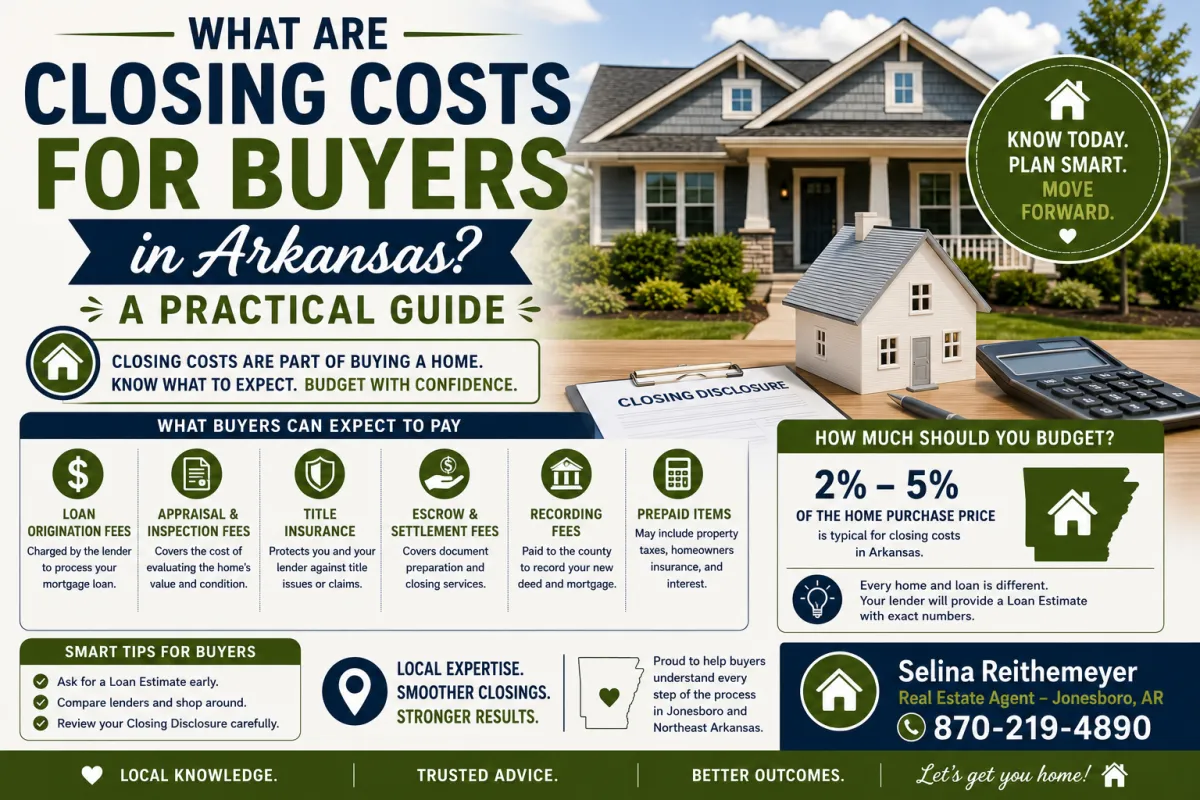
What Are Closing Costs for Buyers in Arkansas? A Practical Guide
What Are Closing Costs for Buyers in Arkansas? A Practical Guide
Quick answer: Buyer closing costs can include lender fees, title and settlement charges, recording fees, prepaid taxes and insurance, escrow funding, appraisal costs, and other transaction expenses. Nationally, buyers pay an average of $4,661 in lender and title fees alone, about 1.6% of the average home price, according to 2025 data reported by Bankrate; once transfer taxes and prepaids are added, total closing costs commonly run 2-5% of the purchase price. The exact amount varies by loan, property, lender, and contract. Buyers should request a detailed loan estimate and closing disclosure so they understand their expected cash-to-close.
The purchase price isn't the only number you need to know when buying a home.
You also need to know how much cash you'll need to get to the closing table. That's where closing costs come in.
For first-time buyers especially, the terminology can be confusing. You may hear about closing costs, prepaids, escrow, earnest money, cash to close, and down payment. They're related, but they're not all the same thing.
Understanding the difference can make the buying process much easier, and knowing the rough scale helps too. According to Bankrate's 2025 analysis of LodeStar data, the national average closing cost for a purchase mortgage is $4,661 in lender and title fees, or roughly 1.6% of the average sales price. Add transfer taxes, prepaid property taxes, and prepaid insurance, and most buyers land in the 2-5% range of the purchase price.
What Are Closing Costs?
Closing costs are the expenses associated with completing a real estate transaction. For a buyer, these may include costs connected to: mortgage financing, title work, settlement, recording, prepaid taxes, homeowners insurance, escrow funding, appraisal, and other required services.
The exact charges depend on the transaction.
Are Closing Costs the Same as the Down Payment?
No.
Your down payment is the portion of the purchase price you are paying upfront rather than financing. Closing costs are separate transaction expenses.
For example, a buyer could have: down payment + closing costs + prepaid/escrow amounts = total cash needed at closing. The exact calculation depends on the loan and transaction.
Down Payment vs. Closing Costs vs. Prepaids
| Category | What It Is | Typical Range |
|---|---|---|
| Down payment | Portion of the purchase price paid upfront rather than financed | Varies by loan program, often 3-20%+ of price |
| Closing costs | Lender, title, and settlement fees to complete the transaction | ~1.6% of price (fees alone), per Bankrate/LodeStar |
| Prepaids/escrow | Advance funding for taxes, insurance, and interest | Varies by closing date and tax/insurance cycle |
Source: Bankrate, "Mortgage closing costs," 2025 LodeStar data
What Does a Buyer Typically Pay Before Closing?
Some expenses can occur before the closing date. For example, buyers may pay for: home inspection, appraisal, certain loan-related services, and earnest money.
Whether and when each expense is paid depends on the transaction. Some amounts paid earlier may be credited toward the buyer's required funds at closing, depending on the nature of the expense and transaction.
What Is Earnest Money?
Earnest money is a deposit made according to the purchase contract. It demonstrates the buyer's commitment to the transaction.
It is not necessarily an additional expense on top of everything else. Depending on the contract and transaction, earnest money may be applied toward the buyer's funds due at closing. The contract controls what happens to the deposit.
What Are Prepaid Costs?
Some costs associated with homeownership are collected at closing in advance. These can include items such as: homeowners insurance, property taxes, interest, and initial escrow deposits.
The amount depends on the lender, closing date, tax cycle, insurance requirements, and other factors. This is one reason the cash required at closing can be higher than buyers expect.
Can the Seller Pay Some of the Buyer's Closing Costs?
Sometimes.
A purchase contract may include negotiated seller concessions or credits, subject to the terms of the contract and applicable lender rules. However, buyers should not assume the seller will pay their costs. The ability to negotiate concessions depends on the market, property, seller, offer, financing, and other circumstances.
Does the Loan Type Affect Closing Costs?
Yes.
Different loan programs have different requirements, fees, and structures. Your lender can explain how your particular financing affects the expected costs. That's why online calculators can only give you a rough estimate. Your actual transaction documents are much more useful.
What Should You Ask Your Lender?
Ask for a detailed explanation of your expected cash to close. Questions might include: How much is my down payment? What are my lender fees? How much should I expect for prepaid taxes? How much is being collected for insurance? What is going into escrow? Which costs are being paid before closing? Are there seller credits? How much cash should I plan to bring?
Don't be afraid to ask the lender to explain every unfamiliar line item.
What Should You Budget for After Closing?
Don't spend every dollar you have getting the keys. You may immediately need money for: moving, utilities, furniture, locks, repairs, appliances, lawn care, and maintenance.
Even a well-maintained home can have unexpected expenses. Having an emergency reserve can make homeownership much less stressful.
Frequently Asked Questions
How much are closing costs for buyers in Arkansas?
There is no single amount that applies to every buyer. Nationally, lender and title fees alone average about $4,661, or roughly 1.6% of purchase price, according to Bankrate's 2025 data. Total costs including taxes and prepaids commonly reach 2-5% of the purchase price. Costs vary based on the purchase price, loan, lender, property, and other transaction details.
Are closing costs separate from the down payment?
Yes. The down payment is part of the purchase price. Closing costs are expenses associated with completing the transaction.
Can the seller pay my closing costs?
Sometimes, depending on the contract, market conditions, seller willingness, and lender guidelines.
When do buyers pay closing costs?
Many buyer closing costs are paid at closing, although some expenses, such as an inspection or appraisal, may be paid earlier.
Is earnest money part of closing costs?
Earnest money is a contract deposit and may be credited toward the buyer's funds due at closing, depending on the transaction.
What is cash to close?
Cash to close is the amount the buyer needs to provide to complete the transaction after accounting for items such as the down payment, closing costs, credits, deposits, and other adjustments.
Can I roll closing costs into my mortgage?
That depends on the loan program, lender, property, and transaction structure. Ask your lender what options are available.
Final Thoughts
Closing day should not be the first time you learn how much money you need to buy a home.
Start the conversation early. Understand your down payment. Understand your closing costs. Ask about prepaids and escrow. Know what you've already paid. And understand your estimated cash to close.
The more prepared you are financially, the more confident you'll feel when you finally sit down at the closing table.
Jonesboro, AR Property Taxes: What Homebuyers Should Know
What to Consider When Making an Offer on a Home in Jonesboro, AR
Selina Reithemeyer
Executive Broker, Image Realty
3501 Stonegate Dr, Suite D, Paragould, AR 72450
870-219-4890
